
friends i am collecting some really fantastic stuff for blog, so it may take week or so, please get intact with the posts as revision will make you grab them better...
Wednesday, 18 September 2013
Tuesday, 3 September 2013


Friday, 30 August 2013
PUT THE ABOVE TOGETHER :
Now let's mix some of these traits and see what we come up with.

1. A writer with heavy pressure and a vertical slant.
Heavy pressure= strong emotions and vertical slant= trying to hold emotions back. This writer is usually the one who keeps his wits about him. When "all hell breaks loose," his head rules. He will not be as emotionally responsive as a right slant writer and will "keep cool". This "heavy pressure-vertical slant" writer won't be able to keep his cool all of the time. When his emotions get the best of him he may "fly off the handle" at unpredictable times.
2. A person with light pressure writing (not much emotional or physical energy) and a left slant (tries to avoid emotional situations). This person will be emotionally withdrawn, cold, indifferent and self centered.
There are many steps involved in creating a complete personality profile. Using these first two steps you can begin to put together your own "profile" which can be useful in both personal and professional relationships.

1. A writer with heavy pressure and a vertical slant.
Heavy pressure= strong emotions and vertical slant= trying to hold emotions back. This writer is usually the one who keeps his wits about him. When "all hell breaks loose," his head rules. He will not be as emotionally responsive as a right slant writer and will "keep cool". This "heavy pressure-vertical slant" writer won't be able to keep his cool all of the time. When his emotions get the best of him he may "fly off the handle" at unpredictable times.
2. A person with light pressure writing (not much emotional or physical energy) and a left slant (tries to avoid emotional situations). This person will be emotionally withdrawn, cold, indifferent and self centered.
There are many steps involved in creating a complete personality profile. Using these first two steps you can begin to put together your own "profile" which can be useful in both personal and professional relationships.

Tuesday, 27 August 2013
Be careful with someone like this:
- Handwriting slant determines emotional expressiveness
- The slant is a major indicator for extroversion or introversion
- Right slant indicates compliance with people
- Right slant shows an emotionally expressive person
- Right slanted writers will act according to emotions
- Pressure levels determine how intense the emotions are expressed
- Upright slant shows emotional reserve, suppression, and self-reliance
- Upright slant writers act with their head not their heart
- Upright slant writers are cool under pressure
- Leftward slant writers are emotionally cold and defiant
- Leftward slanted people are self-centered and/or selfish
- Leftward writers are often writers, poets, or artists
- Overly right slant writers cannot control their emotions
- Variable slants identify mostly emotionally unstable writers.
Handwriting Analysis: Slant

DIRECTIONS: Look at the chart to measure how far you slant. Slant reveals the degree to which you express your real emotional feelings to others, depending on your mood. (Does not matter if you’re left-handed or right-handed)
LEFTWARD: \\
Slant A — Emotionally ill. Totally emotionally repressed (keeps back) and locked up in his or her own world. Cannot be reached. Leans over backward to avoid emotional situations. Past- and self-oriented. (Among convicted rapists, there is a preponderance of leftward slanters. An inability to properly express real feelings.)
Slant B — Represses (keeps back) real emotional feelings. Appears cold, evasive (avoids answering directly), and self-absorbed. Independent, hard to fathom (understand), and difficult to get along with.
Slant C — Represses real emotional feelings. Cool exterior masks inhibited reactions. Diplomatic, reserved, not straightforward. (This is saying that how you react on the outside isn’t really how you feel on the inside; you put a mask on.)
VERTICAL: lll
Slant D — Suppresses (puts an end to) emotional responses. Head over heart. It is very difficult to write this way unless you have complete emotional self-control. Undemonstrative, independent, detached, cautious, diplomatic attitude. (Britains are taught to write this way)
RIGHTWARD: ///
Slant E — Moderate expression of feelings. Healthy emotional responses. (70% of Americans write this way - the Palmer Method)
Slant F — Dominated by emotions. Heart over head. Intensely ardent (enthusiastic/passionate), affectionate, friendly, sensitive, jealous. Emotional brushfire.
Slant G — Carried away by emotionalism. Heart rules the head. Excessively fervent (displaying passionate intensity), ardent, romantic, touchy, oversensitive, nervous, high-strung (highly intense), capable of hysterical outbursts. Difficult to get along with. Volatile (explosive behavior). (After collecting and studying the writing of hundreds of murderers, graphologists have found that most of them have a very far rightward slant. They lack emotional control. We may all have murderous feelings, but we don’t act upon them.)
UNSTABLE: // \ ||
In all directions (in a short period of time) — Unstable person. Unpredictable, nervous, erratic, undisciplined, excitable, fickle, capricious, lacking in good judgement and common sense. As if you’re pulled in all directions. (These people might have a warm personality at the moment, but will have a cold attitude the next minute)
The Slant of the Writing: What Does it Mean?
The slant is the second indicator to look for. The slant indicates the writers emotional response to external forces.
1) A right slant (////) signals one who responds strongly to emotional situations. They are caring, warm and outgoing-- their heart rules their mind.
2) A vertical slant (llll) writer tries to keep their emotions in check-- mind rules their heart.
3) A left slant writer (\\\\) will conceal their emotions and is observed as cold and indifferent.


1) A right slant (////) signals one who responds strongly to emotional situations. They are caring, warm and outgoing-- their heart rules their mind.
2) A vertical slant (llll) writer tries to keep their emotions in check-- mind rules their heart.
3) A left slant writer (\\\\) will conceal their emotions and is observed as cold and indifferent.


Sunday, 25 August 2013
What Aaron Hernandez’s handwriting may reveal:

The pressure applied by the writer, the slant of the letters, the look of crossed t’s and dotted i’s, the amount of space between words all create a unique profile, they say.
“Handwriting does not lie,” said Ronald Rice, a forensic handwriting examiner and certified graphoanalyst with 36 years’ experience.
Recognizing that handwriting analysis has supporters and skeptics, the Globe asked Rice to analyze the handwriting of Aaron Hernandez from two jailhouse notes posted online by TMZ that presumably were written by the former Patriots tight end.
Rice, owner and director of Checkmate Forensic Services, Inc., is qualified to examine handwriting for courts in seven states, including Massachusetts. He has done profiles of Timothy McVeigh and O.J. Simpson, and has been retained by companies for pre-employment screening.
Using Trait Theory, an approach to personality study that focuses on patterns of behavior and emotions and uses categories like introvert and extrovert, Rice provides information on a writer’s emotional intensity, social tendencies, and hostility level in certain situations. Rice bases his analysis on his experience and a system developed by psychologists who examined and compared thousands of writing samples.
The traits he believes are reflected in this handwriting sample may make for a good fit with the Patriots on the field but may be less advantageous, even concerning, off the field.
“I would’ve told [Bill] Belichick this: You’ve got a good guy here,” said Rice, who also consults for private detective Jay Groob and American Investigative Services. “Hernandez is not a problematic individual. He’ll roll with the punches. He may get along with others, but basically he’s a loner. He prefers to be able to come and go as he pleases.
“But when he’s out on the field and when he’s in the locker room, he’ll be a team player. He’s not going to blab about Patriots secrets. He’s not going to be backstabbing any of the guys. He’ll do what he’s told because he’s submissive.”
Here is how he came to that determination:
■ Letter slant: Rice concluded that the slightly leftward slant of Hernandez’s letters points toward an introvert who is “extremely self-protective” and suppresses his emotions. “He’s not going to give you information just because you asked for it,” said Rice. “He’s too logical. He’s going to ask, ‘Why do you want to know this? What are you going to do with it? How can I trust you?’ ”
The presence of unslanted letters also indicates an ambivert. The combination of slightly left slanted and unslanted letters translates into someone who prefers one or two close friends and demands absolute loyalty from those friends. The ambivert part of Hernandez’s personality means that, according to Rice, “he’ll do what’s in the best interest of everybody, as long as he doesn’t get hurt.” But, Rice added, “If he is provoked or experiences an unexpected, real or imagined, offense from a friend or family member, he may not be able to suppress his emotions.”
■ Writing pressure: Rice determines pressure by the thickness of different letter strokes, and pressure indicates “how much gasoline someone has, how volatile he will be if he gets into a situation.”
On a scale from 1 to 6, the pressure applied by Hernandez fell between 3 and 3.5, which rates as “average” or “moderate.” McVeigh was a 3 and Simpson a 4. Rice noted that “most people involved with road rage or explosive, violent actions usually fall within the moderate range” and that the moderate range is “the normal range for almost everyone walking around today.”
■ Word spacing: With relatively large spaces between his words, Hernandez scored high in “generosity.” But in combination with other traits, his generosity is manipulative. “Mr. Hernandez uses his extreme generosity as a means of gaining approval,” wrote Rice. “Basically, he uses generosity as a weapon to buy, intimidate and/or seduce his person of interest.”
■ Letter formation: Hernandez also scored high in the “yielding/submissive” trait. This conclusion comes from the bottom portion of his lower-case “p,” which does not swing out but remains perfectly vertical. This submissive tendency may have made Hernandez a good fit with Belichick and the Patriots.
When it comes to crossing t’s, the crossbar appears very high in some words and very low in others. Rice said this indicates someone with fluctuating self-confidence. One moment he is “flying high” and the next he is having second thoughts about himself.
Also, the crossbar mostly falls to the right side of the stem, a sign of irritation. And in several instances, the lower-case “t” comes down hard on the notepad lines, which Rice said shows decisiveness.
Two other revealing letters, according to Rice, are the lower-case “a” and “o.” In many instances, they are closed circles, indicating someone who is “secretive and can also be reticent.” But both letters sometimes show small openings, which is common in people who are open and talkative.
Asked about the presence of both closed and open ovals, Rice said, “He can be congenial, good at small talk, but not talk about anything private. You do not go into his private world unless he allows you to.”
Begin with the confidence:
Determine the emotional energy of the writer. This is the most important factor of the personality of the writer. The emotional energy has a direct impact on every other trait displayed in the handwriting. Emotional energy is determined by how much pressure the writer uses when he writes. If you examine the writing you can determine how much pressure was used by how "dark" the writing is. Also, if you turn the page over and feel the underside you can feel how much pressure was used (especially if the sample was written on a soft surface).
Emotional energy is a combination of the physical and mental energy level. Writers with heavy pressure are usually highly successful. They have a lot of vitality and their emotional experiences last for a long time. Writers who write with average pressure are usually moderately successful and usually have enough energy to make it through the day. Those with light pressure try to avoid energy draining situations.
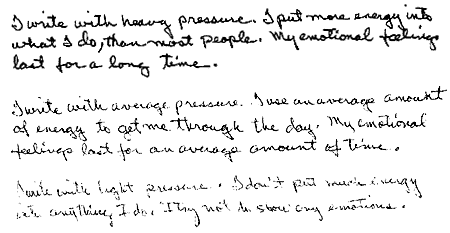
Emotional energy is a combination of the physical and mental energy level. Writers with heavy pressure are usually highly successful. They have a lot of vitality and their emotional experiences last for a long time. Writers who write with average pressure are usually moderately successful and usually have enough energy to make it through the day. Those with light pressure try to avoid energy draining situations.
Lets put all together :
From now onwards the post will follow sequence , to help you move along the right path, telling you what to observe at the first sight.....
BE READY.......
BE READY.......
Friday, 23 August 2013
SPEED:
Speed is found in the flow of the writing and indicates speed of thought, action and perception. Additionally, writing that has few or no beginning strokes shows the stripping away of unnecessary details contributing to the applicant's efficiency in getting the job done. Note the T-crosses. If the cross is longer on the right side of the stem than on the left side, the writer is hurrying to complete his simple task of crossing the t. 1-dots which fall to the right of the stem also indicate speed.
FASTWRITING =


FASTWRITING =
alertness
perceptiveness
flexibility
maturity
rapid thinker

SLOWWRITING =
slow thinker
delibrate
cautious thinker
precision

Thursday, 22 August 2013
Analyzing Handwriting: Speed and Curves::
The speed of a person's writing reveals additional personality traits. Speed is found in the flow of the writing and indicates speed of thought, action and perception. This trait can vary when people are taking notes or in a hurry such as a doctor signing a prescription.
Those who write swiftly tend to be alert, flexible, rapid thinkers.
Those who write slowly are those who take the time to consider details, deliberate, cautious people.
Curves and Angles:
Writing that begins with a curve indicates a person who may be stuck in the past. Curves at the end of a letter or word indicates a person's level of generosity.
Rest to be continued----
Those who write swiftly tend to be alert, flexible, rapid thinkers.
Those who write slowly are those who take the time to consider details, deliberate, cautious people.
Curves and Angles:
Writing that begins with a curve indicates a person who may be stuck in the past. Curves at the end of a letter or word indicates a person's level of generosity.
Rest to be continued----
Wednesday, 21 August 2013
Sensitivity to Criticism:
Sensitivity to Criticism is evident in handwriting. Sensitivity to criticism is a common fear trait, acquired through continued disapproval and also nurtured by recurring hurts or rejection.
If you as a child met with frequent criticism, especially from those whose good opinion you valued or desired, your self-image may have deteriorated to the point where you have formed a habit of imagining unfavourable attitudes where in truth none exist.
The sensitivity discussed here is produced when there is repeated damage to a person’s ego that results in the person having a continuing fear of hurts, even imagined ones. This type of person may well have the habit of imagining unfavourabe attitudes where in truth none exist.
It is ironic that as much as sensitive people need assurance through praise, they often deprive themselves of it by refusing to enter into situations where there is even a chance they will encounter criticism. In a sense, they have their ears plugged to avoid hearing words of disapproval, and, in the process, they don’t hear words of praise, either!
The primary indication of sensitivity to criticism in handwriting is where there are the loops in the stems of ‘t’ and ‘d’ letters (letters which do not have looped stems in standard script). T’s and d’s embody pride and the elements of self-esteem. A loop, no matter where it occurs in writing, is imagination. When added to a ‘t’ or ‘d’ stem, this indicates a real or imagined view on the part of the writer of what other people think about their ideas, habits or actions. The more inflated the looped stems, the greater their fear of and sensitivity to criticism is.
Looped ‘d’ and ‘t’ Stems: Sensitivity to Criticism and Guilt


If you as a child met with frequent criticism, especially from those whose good opinion you valued or desired, your self-image may have deteriorated to the point where you have formed a habit of imagining unfavourable attitudes where in truth none exist.
The sensitivity discussed here is produced when there is repeated damage to a person’s ego that results in the person having a continuing fear of hurts, even imagined ones. This type of person may well have the habit of imagining unfavourabe attitudes where in truth none exist.
It is ironic that as much as sensitive people need assurance through praise, they often deprive themselves of it by refusing to enter into situations where there is even a chance they will encounter criticism. In a sense, they have their ears plugged to avoid hearing words of disapproval, and, in the process, they don’t hear words of praise, either!
The primary indication of sensitivity to criticism in handwriting is where there are the loops in the stems of ‘t’ and ‘d’ letters (letters which do not have looped stems in standard script). T’s and d’s embody pride and the elements of self-esteem. A loop, no matter where it occurs in writing, is imagination. When added to a ‘t’ or ‘d’ stem, this indicates a real or imagined view on the part of the writer of what other people think about their ideas, habits or actions. The more inflated the looped stems, the greater their fear of and sensitivity to criticism is.
Looped ‘d’ and ‘t’ Stems: Sensitivity to Criticism and Guilt
Loops in handwriting refer to imagination and emotional reception relative to the zone you find them in.
The d and t letters focus on aspects of the personality ego. The ‘d’ relates to one’s personal mannerism, his speech, physical attributes, manner of dress; his physical personality ego. The ‘t’ relates to the individual’s philosophical beliefs, ideals, code of ethics, education, intentions, and plans; his mental personality ego.
Extreme Sensitivity to Criticism
Excessively large loops in the d or t represent the writer who is so extremely sensitive to criticism that he is accused of being “paranoid” by those who interact with him. Wide line spacing further verifies the paranoid personality disorder.
When he feels criticized, his imagination becomes quite enlarged just as the loop structure becomes enlarged. He will listen to every conversation and be able to mentally process it in such a way that he justifies his suspicion of others. He is constantly hurt, feeling very lonely, and believing everyone is against him. For the extremely sensitive personality, that which he experiences in his imagination (loops = imagination) is more real than reality. The subconscious mind does not know fact from fiction.
Monday, 19 August 2013
Size and Extension of Letters
The size of a writer's letters handwriting in relation to spaces is an indication of their sense of ego. Handwriting that features large letters typically represents a friendly and social person. Someone who writes with tiny letters is most likely an introvert. Most people's handwriting is in the middle range making them a balance between the two extremes.
The upper and lower loops in a person's handwriting reveal many personality traits.
Tall Upper Loops:
Elaborate upper letters such as l's, d's, and h's indicate an abstract thinker with great intellect. This quality is often found in the handwriting of philosophers. The taller the loops, the more intelligent the person is. The shorter the loops to the top of the line is a sign of average intelligence.
Expressive or Large Lower Loops:
Those with expressive or large loops that go below the writing line, such as the letter y and the lower case g indicate a sensual person who is driven and physical. These people often have very high sex drives and stay active throughout their lives. The more unique the loop, the more likely the individual is to be an original person (and a skilled lover). Short loops in letters that go below the writing line indicate the opposite. Those who write with very small loops are typically couch potatoes who avoid physical activity.
The more plump the loop in the lower letter indicates a person who's needs are not being met. A significant y or g with an elaborated loop indicates someone who isn't making as much money as they wish they were and may not be getting enough physical attention.
Lower loops that are backwards may indicate someone who has unusual sexual desires.
No Loops in the Upper or Lower Letters:
Some people write letters in a printing style without loops in letters such as l and instead use frill free straight lines. These writers are serious, practical people who tend to be stoic.


The upper and lower loops in a person's handwriting reveal many personality traits.
Tall Upper Loops:
Elaborate upper letters such as l's, d's, and h's indicate an abstract thinker with great intellect. This quality is often found in the handwriting of philosophers. The taller the loops, the more intelligent the person is. The shorter the loops to the top of the line is a sign of average intelligence.
Expressive or Large Lower Loops:
Those with expressive or large loops that go below the writing line, such as the letter y and the lower case g indicate a sensual person who is driven and physical. These people often have very high sex drives and stay active throughout their lives. The more unique the loop, the more likely the individual is to be an original person (and a skilled lover). Short loops in letters that go below the writing line indicate the opposite. Those who write with very small loops are typically couch potatoes who avoid physical activity.
The more plump the loop in the lower letter indicates a person who's needs are not being met. A significant y or g with an elaborated loop indicates someone who isn't making as much money as they wish they were and may not be getting enough physical attention.
Lower loops that are backwards may indicate someone who has unusual sexual desires.
No Loops in the Upper or Lower Letters:
Some people write letters in a printing style without loops in letters such as l and instead use frill free straight lines. These writers are serious, practical people who tend to be stoic.

The larger the handwriting, the more the writer seeks attention.

Sexuality and Individuality can be revealed in handwriting

Check o's and a's to get an idea of how a person will communicate.
Sunday, 18 August 2013
Handwriting Analysis of Realhousewife
One of Hubpage's most beloved Hubbers, RealHousewife, Kelly Umpenhour was named the MOST CHEERFUL HUBBER of 2011 and 2012. Kelly cheerfully agreed to provide a handwriting sample for analysis. Here are the results of Kelly's handwriting analysis:
Kelly's writing immediately says she is highly communicative, open, and honest. Her writing is very stylish and this trait suggests she is also very stylish in her dress and decor. Initial analysis of her writing shows she is highly sociable, responsive, and extrovert, outgoing, and cheerful. She is optimistic and upbeat with a positive attitude.
Almost every ending letter in Kelly's handwriting has a loop that curves up. This suggests Kelly is a very generous and self sacrificing person. Because it occurs on almost every letter, this writer may be generous to a fault and it is assumable that her children are very well cared for.
Kelly's writing is on the large side. This signifies that she is highly confident. She likes to be noticed, but she isn't theatrical and doesn't bring attention to herself.
The straight slant mark at the beginning of several letters suggests Kelly dislikes being told what to do and how to do it. The loops in her letter "d's" signify she she thinks philosophy is a bunch of bull and she is not impressed by it or politics. The way Kelly crosses her hubs indicates she is very self driven and sets high goals for herself.
The loops on Kelly's "y's" tells us she is a highly physical, sensual person with a high sex drive and a freaky lover. (And.. sorry fellows, she is happily married). She is extremely organized, with a great sense of decor and you can make any space beautiful. The Realhousewife is not only cheerful, but dynamic.

Kelly's writing immediately says she is highly communicative, open, and honest. Her writing is very stylish and this trait suggests she is also very stylish in her dress and decor. Initial analysis of her writing shows she is highly sociable, responsive, and extrovert, outgoing, and cheerful. She is optimistic and upbeat with a positive attitude.
Almost every ending letter in Kelly's handwriting has a loop that curves up. This suggests Kelly is a very generous and self sacrificing person. Because it occurs on almost every letter, this writer may be generous to a fault and it is assumable that her children are very well cared for.
Kelly's writing is on the large side. This signifies that she is highly confident. She likes to be noticed, but she isn't theatrical and doesn't bring attention to herself.
The straight slant mark at the beginning of several letters suggests Kelly dislikes being told what to do and how to do it. The loops in her letter "d's" signify she she thinks philosophy is a bunch of bull and she is not impressed by it or politics. The way Kelly crosses her hubs indicates she is very self driven and sets high goals for herself.
The loops on Kelly's "y's" tells us she is a highly physical, sensual person with a high sex drive and a freaky lover. (And.. sorry fellows, she is happily married). She is extremely organized, with a great sense of decor and you can make any space beautiful. The Realhousewife is not only cheerful, but dynamic.

Saturday, 17 August 2013
Detecting laziness:
Rounded Letter: Writing of this type has rounded formations. It seems as if the writer has written in comfort and at leisure. These people are lazy, luxurious, and hate to do hard work. They have all the time in the world to chat but still think that they are busy. However, they are also peace- loving, law-abiding and crave the better things in life.
Procrastination:
 Each stroke in your handwriting reveals something about you. Take a look at the lower-case 't's in your handwriting and notice how you cross them. Is more of the t-bar located on the left side of the stem, more on the right, are they equally balanced, or do you see some of each? A 't' crossed predominately on the left is a sign of procrastination. When you don't finish crossing a 't', you are expressing that something is unfinished in your life. If most of your 't's are crossed on the left, then you habitually procrastinate. But is procrastination a bad thing?
What is Passive Procrastination?
If you put things off because you have trouble making decisions, when you are overwhelmed by an upcoming task, or you can't get motivated, you are a passive procrastinator. Fear, stubbornness, anger, defiance, or low self-esteem can unconsciously trigger procrastination. If you don't meet a deadline or you make mistakes in the rush to complete a task, you may feel out of control, stressed, depressed or embarrassed. Unless you don't care, which is another topic altogether!
What is Active Procrastination?
On the other hand, if you consciously put off a task or a decision because you need more time to plan or investigate, or because you already have too much on your plate, then you are actively procrastinating. You aren't avoiding a task. You are prioritizing and taking steps to successfully complete it. You may or may not finish on time, but you will not feel like a failure under those circumstances.
Procrastination is a complex trait.
Balanced t-bar handwriting sample I have only scratched the surface here. Whether you are a passive or active procrastinator, look at the nature of the things you put off to discover when and why you do so. Find ways to resolve those issues.
 To help eliminate procrastination, start crossing your 't's with the same amount of t-bar on the left of the stem as on the right. You will eventually create a new neural pathway in your brain to establish the behavior of getting things done.
i dot: An “i”-dot which is placed to the left side of the stem is a sure shot sign of procrastination and also highlights negative attitude. It also points out lack of self-confidence. The placement of “i” dot to the left of the stem represents the past and reveals that the writer loves to live in the past.
Short lower loops: expose the individual entirely disinterested in physical activity.
disinterested in physical activity, possible laziness ,sedentary.
 Pressure:Pressure takes a certain amount of physical exertion, and the soft-tipped pen user enjoys the easy flow of ink over the page. Soft-tipped pens are a cop-out for physical labor. However, they are also used by artists and sensual people. Check with other Trait match signs to determine if the writer is lazy.


 CLARITY:
Clarity involves all of the basic factors of handwriting analysis
in a positive way. It's a good idea to keep in mind that when
clarity in a written sample is combined with-
* A slight, right slant = interest in communicating with others;
* Medium size writing = willingness to contact others physically and mentally
*Balanced expansion = reaching out to become involved.
*Even margins = good sense of self-identity within the environment.
*Good spacing between letters = generosity of time, money energy.
*Good spacing between words = interest in social contacts.
*Good space between lines = ability to think clearly and separate ideas.
* Clear formation of letters = wish to impart information and consideration for others.
Illegible writing, whether scribbled by a world-wise scientist or by your inexperienced job applicant, indicates the individual who doesn't have the time or inclination to communicate. Someone once mentioned that the less legible the writing, the more intelligent the writer. Ever since then, some people have hidden their laziness and inconsideration behind that remark.
One secretary complained, ''My boss is such a terrible writer I can hardly make out what he means. Last week he didn't read over a letter before he signed it and I had typed something all wrong. I got bawled out. I think it was his fault, don't you?''
You bet! But secretaries aren't the only ones who suffer. Ask your local pharmacist, for instance.
Illegible script is the curse of good communication, and writing is-first and foremost -communication.
Many bosses have an executive type of mind; sharp, alert, quick. But the employer who doesn't take the time or effort to make his written thoughts clear enough to be translated by a secretary or anyone else is both inconsiderate and lacking in common sense.
Speed is the prime offender. We think faster than our fingers can move. Unless control is exercised over both thoughts and fingers, the results are usually unreadable.
There are, however, other reasons for illegibility in handwriting. It may be caused by emotional stress or an illness resulting in muscular impairment or hysteria. Also, a dishonest person hides his intentions behind poor writing.
Illegibility maybe caused by more serious reasons than speed or inconsideration. When the physical or mental vitality of a writer is impaired through the use of drugs or alcohol, illegible writing is often a result. The uneven baseline is usually the first clue, signaling the lack of motor control. Letters not clearly formed due to speed may occur in everywriting at anytime, but when a sequence of letters fails to make sense, there is more than speed or inconsistency at work. If this is repeated on a page or two of writing, drop that application in the round file. You don't need the problems that can be brought to your workplace by this kind of employee.
III health often shows up in illegible writing especially if the writing also has weak pressure. There just is not enough vitality there for the writer to get through a good day's work. However, we all have our off days. If all other factors are favorable, and you might like to have him on your work team, suggest he comeback another time to repeat his writing sample.
Small letter “f”: made with return strokes turned sharply to left denotes a vindictive nature. Such a person is revengeful and very lazy.
The base line: that show pessimism is also the indicator of lazyness , if pressure is light
**********************************************
Experience the thrill of analyzing handwriting! Entertain family and friends by showing them what their handwriting reveals.
Procrastination:

What is Passive Procrastination?
If you put things off because you have trouble making decisions, when you are overwhelmed by an upcoming task, or you can't get motivated, you are a passive procrastinator. Fear, stubbornness, anger, defiance, or low self-esteem can unconsciously trigger procrastination. If you don't meet a deadline or you make mistakes in the rush to complete a task, you may feel out of control, stressed, depressed or embarrassed. Unless you don't care, which is another topic altogether!
What is Active Procrastination?
On the other hand, if you consciously put off a task or a decision because you need more time to plan or investigate, or because you already have too much on your plate, then you are actively procrastinating. You aren't avoiding a task. You are prioritizing and taking steps to successfully complete it. You may or may not finish on time, but you will not feel like a failure under those circumstances.
Procrastination is a complex trait.
Balanced t-bar handwriting sample I have only scratched the surface here. Whether you are a passive or active procrastinator, look at the nature of the things you put off to discover when and why you do so. Find ways to resolve those issues.

i dot: An “i”-dot which is placed to the left side of the stem is a sure shot sign of procrastination and also highlights negative attitude. It also points out lack of self-confidence. The placement of “i” dot to the left of the stem represents the past and reveals that the writer loves to live in the past.
Short lower loops: expose the individual entirely disinterested in physical activity.
disinterested in physical activity, possible laziness ,sedentary.

HEAVY PRESSURE =

MEDIUM PRESSURE =
perceptive
good memory
conservative

LIGHT PRESSURE =
gentle, cultural
avoids confrontation
sedentary
prefers intellectual approach

Clarity involves all of the basic factors of handwriting analysis
in a positive way. It's a good idea to keep in mind that when
clarity in a written sample is combined with-
* A slight, right slant = interest in communicating with others;
* Medium size writing = willingness to contact others physically and mentally
*Balanced expansion = reaching out to become involved.
*Even margins = good sense of self-identity within the environment.
*Good spacing between letters = generosity of time, money energy.
*Good spacing between words = interest in social contacts.
*Good space between lines = ability to think clearly and separate ideas.
* Clear formation of letters = wish to impart information and consideration for others.
Illegible writing, whether scribbled by a world-wise scientist or by your inexperienced job applicant, indicates the individual who doesn't have the time or inclination to communicate. Someone once mentioned that the less legible the writing, the more intelligent the writer. Ever since then, some people have hidden their laziness and inconsideration behind that remark.
One secretary complained, ''My boss is such a terrible writer I can hardly make out what he means. Last week he didn't read over a letter before he signed it and I had typed something all wrong. I got bawled out. I think it was his fault, don't you?''
You bet! But secretaries aren't the only ones who suffer. Ask your local pharmacist, for instance.
Illegible script is the curse of good communication, and writing is-first and foremost -communication.
Many bosses have an executive type of mind; sharp, alert, quick. But the employer who doesn't take the time or effort to make his written thoughts clear enough to be translated by a secretary or anyone else is both inconsiderate and lacking in common sense.
Speed is the prime offender. We think faster than our fingers can move. Unless control is exercised over both thoughts and fingers, the results are usually unreadable.
There are, however, other reasons for illegibility in handwriting. It may be caused by emotional stress or an illness resulting in muscular impairment or hysteria. Also, a dishonest person hides his intentions behind poor writing.
Illegibility maybe caused by more serious reasons than speed or inconsideration. When the physical or mental vitality of a writer is impaired through the use of drugs or alcohol, illegible writing is often a result. The uneven baseline is usually the first clue, signaling the lack of motor control. Letters not clearly formed due to speed may occur in everywriting at anytime, but when a sequence of letters fails to make sense, there is more than speed or inconsistency at work. If this is repeated on a page or two of writing, drop that application in the round file. You don't need the problems that can be brought to your workplace by this kind of employee.
III health often shows up in illegible writing especially if the writing also has weak pressure. There just is not enough vitality there for the writer to get through a good day's work. However, we all have our off days. If all other factors are favorable, and you might like to have him on your work team, suggest he comeback another time to repeat his writing sample.
Small letter “f”: made with return strokes turned sharply to left denotes a vindictive nature. Such a person is revengeful and very lazy.
The base line: that show pessimism is also the indicator of lazyness , if pressure is light
**********************************************
Experience the thrill of analyzing handwriting! Entertain family and friends by showing them what their handwriting reveals.
Friday, 16 August 2013
Building Concentration part 2:
Hi everyone!
I hope you read the previous blog. If you haven’t, please go back and read it, so that you can join us in learning about your level of concentration!
I hope you practiced writing small and so on. Did you come to any conclusions about the ‘size’ of your handwriting? I hope you will leave me a comment and let me know! Here are more samples of large, and small handwriting as well as medium:

I hope you read the previous blog. If you haven’t, please go back and read it, so that you can join us in learning about your level of concentration!
I hope you practiced writing small and so on. Did you come to any conclusions about the ‘size’ of your handwriting? I hope you will leave me a comment and let me know! Here are more samples of large, and small handwriting as well as medium:

If your handwriting falls in the small category, you have the ability to center attention, to the exclusion of other interest (very good concentration).
The standard height of ‘small’ handwriting is one-sixteenth of an inch-very small. This intense concentration will effect all other traits in handwriting. Got a temper? The intensity of that temper will be greater.
This writer will stay focused on the project at hand. He can shut out the world and concentrate on his work. This kind of writer will not have a wondering mind.
He will come off as very reserved, quiet, not liking a lot of attention on himself. You can count on him to do well under pressure, and he will be sure to pay attention to details.
They may seem non-social, and can stay quite busy alone. So, the very small writer is interesting, a little misunderstood, but usually very focused, and intelligent.
On the other hand…if you have large handwriting, you are a lot more social, and your attentions will be more scattered to many things. Why have one project when you can have 5 going at one time!
This writer likes to be around people, and likes attention. They really need to be appreciated, and loved by other people. They don’t feel comfortable alone.
This person would hate a desk job, he likes to interact with others. These people don’t worry about the small stuff, they just go on to something else. Don’t ignore them-just love them!
Unfortunately, they have scattered energies in all directions, which makes it harder for them to concentrate on one thing at a time. (if you are an emotional person-you will need to ‘waste’ some energy by letting off steam-concentration wouldn’t help here.)
So the larger writer will have many interests, which can make for an interesting person.
The medium writer I guess you would say, has the best of both worlds in a way. He can give a little more attention,but not intensely.
I hope this has helped you in understanding yourself, and others a little more. If you have any questions, I will try and answer them if I can. Leave me a comment of how this has helped you!
Thanks, and God bless! Remember, keep your chin up, and those t-bars higher! I leave you with Proverbs 22:4 “By humility and the fear of the Lord are riches and honor and life.” Amen!
-Ann
Building Concentration:
In handwriting analysis determines the writers ability to concentrate. This trait is indicated by the size of the writing. Small writing points to someone who has the ability to concentrate on minor details for long periods of time. They are not easily distracted by outside forces. These writers include scientists, researchers, bookkeepers, etc. People who write small like to work alone. They can be trusted to take on tedious tasks and follow them through to completion without being side tracked. Those who write small are usually conservative and thrifty.
Most of us write average size, indicating an average ability to concentrate. We have to force ourselves to concentrate on minor details, especially for long periods of time. Large writers are easily distracted. They have trouble concentrating and easily get "off-track." At work, these individuals should be given varying duties and assignments that are quick to complete.
Here is a sample of Albert Einstein's handwriting, actual size.

Get a pen and paper and try to write this small. You will feel your whole body go tense as you concentrate on making the small letters. I have examined this sample with a magnifying glass and every letter is shaped perfectly. It is a beautiful piece of art.
Most of us write average size, indicating an average ability to concentrate. We have to force ourselves to concentrate on minor details, especially for long periods of time. Large writers are easily distracted. They have trouble concentrating and easily get "off-track." At work, these individuals should be given varying duties and assignments that are quick to complete.
Here is a sample of Albert Einstein's handwriting, actual size.

Get a pen and paper and try to write this small. You will feel your whole body go tense as you concentrate on making the small letters. I have examined this sample with a magnifying glass and every letter is shaped perfectly. It is a beautiful piece of art.
Thursday, 15 August 2013
Extra Diet: "If you change your ideas, your way of thinking, your writing will change, too,"
letter e "shows how open-minded they are."
She said that a small e that looks more like an i, or a screw driver, indicates a very closed-minded person.But an e that looks more like an o may mean the person's mind is too open.
Writing that is nearly all the same height, whether capital or small letters or e's or h's, can indicate a lack of balance in one's life.But writing that has a consistent mix of letters at the heights they should be shows a more balanced life.
The style of the loops one makes in a small f also can indicate many things, she said.
For example, if both the upper and lower loops are proportional, with the upper loop slightly smaller and the lower one a bit bigger, the person likely has a strong organizational ability, Rohn-Cook explained.
A tight or no upper loop and a big lower loop indicates a lack of organizational ability, but that person probably could carry out orders well, she said.But a big upper loop and a tiny lower loop may mean someone has lots of ideas, but doesn't necessarily carry them out, she said.
"When you have both upper and lower loops, your philosophy, your belief system are both there," Rohn-Cook said.
She said it's all about staying balanced, even with something as simple as the loop in a small e or as complicated as both loops in a small f.
Rohn-Cook said that cursive handwriting does not indicate whether the writer is a man or a woman, or the person's nationality or race.
She said that a small e that looks more like an i, or a screw driver, indicates a very closed-minded person.But an e that looks more like an o may mean the person's mind is too open.
Writing that is nearly all the same height, whether capital or small letters or e's or h's, can indicate a lack of balance in one's life.But writing that has a consistent mix of letters at the heights they should be shows a more balanced life.
The style of the loops one makes in a small f also can indicate many things, she said.
For example, if both the upper and lower loops are proportional, with the upper loop slightly smaller and the lower one a bit bigger, the person likely has a strong organizational ability, Rohn-Cook explained.
A tight or no upper loop and a big lower loop indicates a lack of organizational ability, but that person probably could carry out orders well, she said.But a big upper loop and a tiny lower loop may mean someone has lots of ideas, but doesn't necessarily carry them out, she said.
"When you have both upper and lower loops, your philosophy, your belief system are both there," Rohn-Cook said.
She said it's all about staying balanced, even with something as simple as the loop in a small e or as complicated as both loops in a small f.
Rohn-Cook said that cursive handwriting does not indicate whether the writer is a man or a woman, or the person's nationality or race.
Document Examiner vs. Graphologist
Handwriting analysis is employed in two different fields. The first is often referred to as "questioned document examination," a branch of the forensic sciences. Document examiners, according to the Association of Forensic Document Examiners, "answer questions relating to the reliability and authenticity of a document which may involve signatures, handwriting in general, or hand printing." This is a different branch of science from graphologists, or graphoanalysts, who examine handwriting characteristics in order to assess the character and personality of an individual. Graphoanalyst is a registered trademark of the International Graphoanalysis Society.
To determine authorship of a particular signature or handwriting sample, a forensic document examiner will consider certain characteristics, including
- Spacing of words and letters
- Ratio of relative height, width, and size of letters
- Pen lifts and separations
- Connecting strokes
- Beginning and ending strokes.
- Unusual letter formation.
- Slant.
- Baseline characteristics
- Flourishes and embellishments
- The length, size, and location of diacritics (dotting of i's and crossing of t's).
Subscribe to:
Posts (Atom)


