Tuesday, 27 August 2013

The Slant of the Writing: What Does it Mean?

The slant is the second indicator to look for. The slant indicates the writers emotional response to external forces.
1) A right slant (////) signals one who responds strongly to emotional situations. They are caring, warm and outgoing-- their heart rules their mind.

2) A vertical slant (llll) writer tries to keep their emotions in check-- mind rules their heart.

3) A left slant writer (\\\\) will conceal their emotions and is observed as cold and indifferent.

Sunday, 25 August 2013

What Aaron Hernandez’s handwriting may reveal:

To hear private detectives tell it, appearances, references, witnesses, and promises of reformed behavior can be deceiving. So some of them — like lawyers, doctors, educators, and military units — turn to handwriting analysis for psychological assessments when investigating someone.

The pressure applied by the writer, the slant of the letters, the look of crossed t’s and dotted i’s, the amount of space between words all create a unique profile, they say.

“Handwriting does not lie,” said Ronald Rice, a forensic handwriting examiner and certified graphoanalyst with 36 years’ experience.

Recognizing that handwriting analysis has supporters and skeptics, the Globe asked Rice to analyze the handwriting of Aaron Hernandez from two jailhouse notes posted online by TMZ that presumably were written by the former Patriots tight end.
Rice, owner and director of Checkmate Forensic Services, Inc., is qualified to examine handwriting for courts in seven states, including Massachusetts. He has done profiles of Timothy McVeigh and O.J. Simpson, and has been retained by companies for pre-employment screening.

Using Trait Theory, an approach to personality study that focuses on patterns of behavior and emotions and uses categories like introvert and extrovert, Rice provides information on a writer’s emotional intensity, social tendencies, and hostility level in certain situations. Rice bases his analysis on his experience and a system developed by psychologists who examined and compared thousands of writing samples.

The traits he believes are reflected in this handwriting sample may make for a good fit with the Patriots on the field but may be less advantageous, even concerning, off the field.

“I would’ve told [Bill] Belichick this: You’ve got a good guy here,” said Rice, who also consults for private detective Jay Groob and American Investigative Services. “Hernandez is not a problematic individual. He’ll roll with the punches. He may get along with others, but basically he’s a loner. He prefers to be able to come and go as he pleases.

“But when he’s out on the field and when he’s in the locker room, he’ll be a team player. He’s not going to blab about Patriots secrets. He’s not going to be backstabbing any of the guys. He’ll do what he’s told because he’s submissive.”

Here is how he came to that determination:

■ Letter slant: Rice concluded that the slightly leftward slant of Hernandez’s letters points toward an introvert who is “extremely self-protective” and suppresses his emotions. “He’s not going to give you information just because you asked for it,” said Rice. “He’s too logical. He’s going to ask, ‘Why do you want to know this? What are you going to do with it? How can I trust you?’ ”

The presence of unslanted letters also indicates an ambivert. The combination of slightly left slanted and unslanted letters translates into someone who prefers one or two close friends and demands absolute loyalty from those friends. The ambivert part of Hernandez’s personality means that, according to Rice, “he’ll do what’s in the best interest of everybody, as long as he doesn’t get hurt.” But, Rice added, “If he is provoked or experiences an unexpected, real or imagined, offense from a friend or family member, he may not be able to suppress his emotions.”

■ Writing pressure: Rice determines pressure by the thickness of different letter strokes, and pressure indicates “how much gasoline someone has, how volatile he will be if he gets into a situation.”

On a scale from 1 to 6, the pressure applied by Hernandez fell between 3 and 3.5, which rates as “average” or “moderate.” McVeigh was a 3 and Simpson a 4. Rice noted that “most people involved with road rage or explosive, violent actions usually fall within the moderate range” and that the moderate range is “the normal range for almost everyone walking around today.”

■ Word spacing: With relatively large spaces between his words, Hernandez scored high in “generosity.” But in combination with other traits, his generosity is manipulative. “Mr. Hernandez uses his extreme generosity as a means of gaining approval,” wrote Rice. “Basically, he uses generosity as a weapon to buy, intimidate and/or seduce his person of interest.”

■ Letter formation: Hernandez also scored high in the “yielding/submissive” trait. This conclusion comes from the bottom portion of his lower-case “p,” which does not swing out but remains perfectly vertical. This submissive tendency may have made Hernandez a good fit with Belichick and the Patriots.

When it comes to crossing t’s, the crossbar appears very high in some words and very low in others. Rice said this indicates someone with fluctuating self-confidence. One moment he is “flying high” and the next he is having second thoughts about himself.

Also, the crossbar mostly falls to the right side of the stem, a sign of irritation. And in several instances, the lower-case “t” comes down hard on the notepad lines, which Rice said shows decisiveness.

Two other revealing letters, according to Rice, are the lower-case “a” and “o.” In many instances, they are closed circles, indicating someone who is “secretive and can also be reticent.” But both letters sometimes show small openings, which is common in people who are open and talkative.

Asked about the presence of both closed and open ovals, Rice said, “He can be congenial, good at small talk, but not talk about anything private. You do not go into his private world unless he allows you to.”

Begin with the confidence:

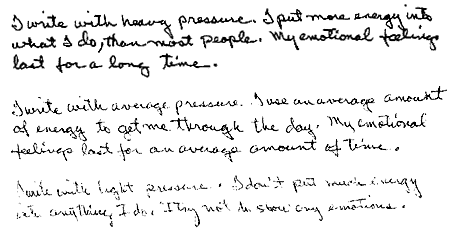
Determine the emotional energy of the writer. This is the most important factor of the personality of the writer. The emotional energy has a direct impact on every other trait displayed in the handwriting. Emotional energy is determined by how much pressure the writer uses when he writes. If you examine the writing you can determine how much pressure was used by how "dark" the writing is. Also, if you turn the page over and feel the underside you can feel how much pressure was used (especially if the sample was written on a soft surface).

Emotional energy is a combination of the physical and mental energy level. Writers with heavy pressure are usually highly successful. They have a lot of vitality and their emotional experiences last for a long time. Writers who write with average pressure are usually moderately successful and usually have enough energy to make it through the day. Those with light pressure try to avoid energy draining situations.

Lets put all together :

From now onwards the post will follow sequence , to help you move along the right path, telling you what to observe at the first sight.....

BE READY.......

Friday, 23 August 2013

SPEED:

Speed is found in the flow of the writing and indicates speed of thought, action and perception. Additionally, writing that has few or no beginning strokes shows the stripping away of unnecessary details contributing to the applicant's efficiency in getting the job done. Note the T-crosses. If the cross is longer on the right side of the stem than on the left side, the writer is hurrying to complete his simple task of crossing the t. 1-dots which fall to the right of the stem also indicate speed.

                                                 FASTWRITING =
alertness 
perceptiveness 
flexibility 
maturity 
rapid thinker 
SLOWWRITING = 
slow thinker 
delibrate 
cautious thinker 
precision 


Thursday, 22 August 2013

Analyzing Handwriting: Speed and Curves::

The speed of a person's writing reveals additional personality traits. Speed is found in the flow of the writing and indicates speed of thought, action and perception. This trait can vary when people are taking notes or in a hurry such as a doctor signing a prescription.

Those who write swiftly tend to be alert, flexible, rapid thinkers.

Those who write slowly are those who take the time to consider details, deliberate, cautious people.

Curves and Angles:

Writing that begins with a curve indicates a person who may be stuck in the past. Curves at the end of a letter or word indicates a person's level of generosity.

Rest to be continued----

Wednesday, 21 August 2013

Sensitivity to Criticism:

Sensitivity to Criticism is evident in handwriting. Sensitivity to criticism is a common fear trait, acquired through continued disapproval and also nurtured by recurring hurts or rejection.

If you as a child met with frequent criticism, especially from those whose good opinion you valued or desired, your self-image may have deteriorated to the point where you have formed a habit of imagining unfavourable attitudes where in truth none exist.

The sensitivity discussed here is produced when there is repeated damage to a person’s ego that results in the person having a continuing fear of hurts, even imagined ones. This type of person may well have the habit of imagining unfavourabe attitudes where in truth none exist.

It is ironic that as much as sensitive people need assurance through praise, they often deprive themselves of it by refusing to enter into situations where there is even a chance they will encounter criticism. In a sense, they have their ears plugged to avoid hearing words of disapproval, and, in the process, they don’t hear words of praise, either!

The primary indication of sensitivity to criticism in handwriting is where there are the loops in the stems of ‘t’ and ‘d’ letters (letters which do not have looped stems in standard script). T’s and d’s embody pride and the elements of self-esteem. A loop, no matter where it occurs in writing, is imagination. When added to a ‘t’ or ‘d’ stem, this indicates a real or imagined view on the part of the writer of what other people think about their ideas, habits or actions. The more inflated the looped stems, the greater their fear of and sensitivity to criticism is.


Looped ‘d’ and ‘t’ Stems: Sensitivity to Criticism and Guilt
Loops in handwriting refer to imagination and emotional reception relative to the zone you find them in.

The d and t letters focus on aspects of the personality ego. The ‘d’ relates to one’s personal mannerism, his speech, physical attributes, manner of dress; his physical personality ego. The ‘t’ relates to the individual’s philosophical beliefs, ideals, code of ethics, education, intentions, and plans; his mental personality ego.

Extreme Sensitivity to Criticism

Excessively large loops in the d or t represent the writer who is so extremely sensitive to criticism that he is accused of being “paranoid” by those who interact with him. Wide line spacing further verifies the paranoid personality disorder.

When he feels criticized, his imagination becomes quite enlarged just as the loop structure becomes enlarged. He will listen to every conversation and be able to mentally process it in such a way that he justifies his suspicion of others. He is constantly hurt, feeling very lonely, and believing everyone is against him. For the extremely sensitive personality, that which he experiences in his imagination (loops = imagination) is more real than reality. The subconscious mind does not know fact from fiction.